Condo boards: master deed vs. HB 395
Condominium documents often contain sweeping restrictions on exterior modifications. HB 395 overrides the ones that prevent balcony solar outright — but the interaction between the statute and existing condo instruments is more layered than it first appears.
Direct answer
Under § 67-701.1 of the Code of Virginia (added by HB 395), condominium declarations and master deeds cannot prohibit a unit owner from installing a compliant plug-in solar system within their exclusive-use space. Provisions in master deeds or bylaws that purport to ban balcony solar outright are unenforceable against compliant systems after January 1, 2027. Condo boards retain architectural review authority, including the right to impose conditions on mounting method, placement, and aesthetics — as long as those conditions don't effectively prevent installation.
How condo law works in Virginia
Virginia condominium law operates under the Virginia Condominium Act (§ 55.1-1900 et seq.). A condominium is created by recording a declaration — the master deed — that divides a property into individual units and common elements, establishes the association's governance structure, and sets the rules that bind all unit owners.
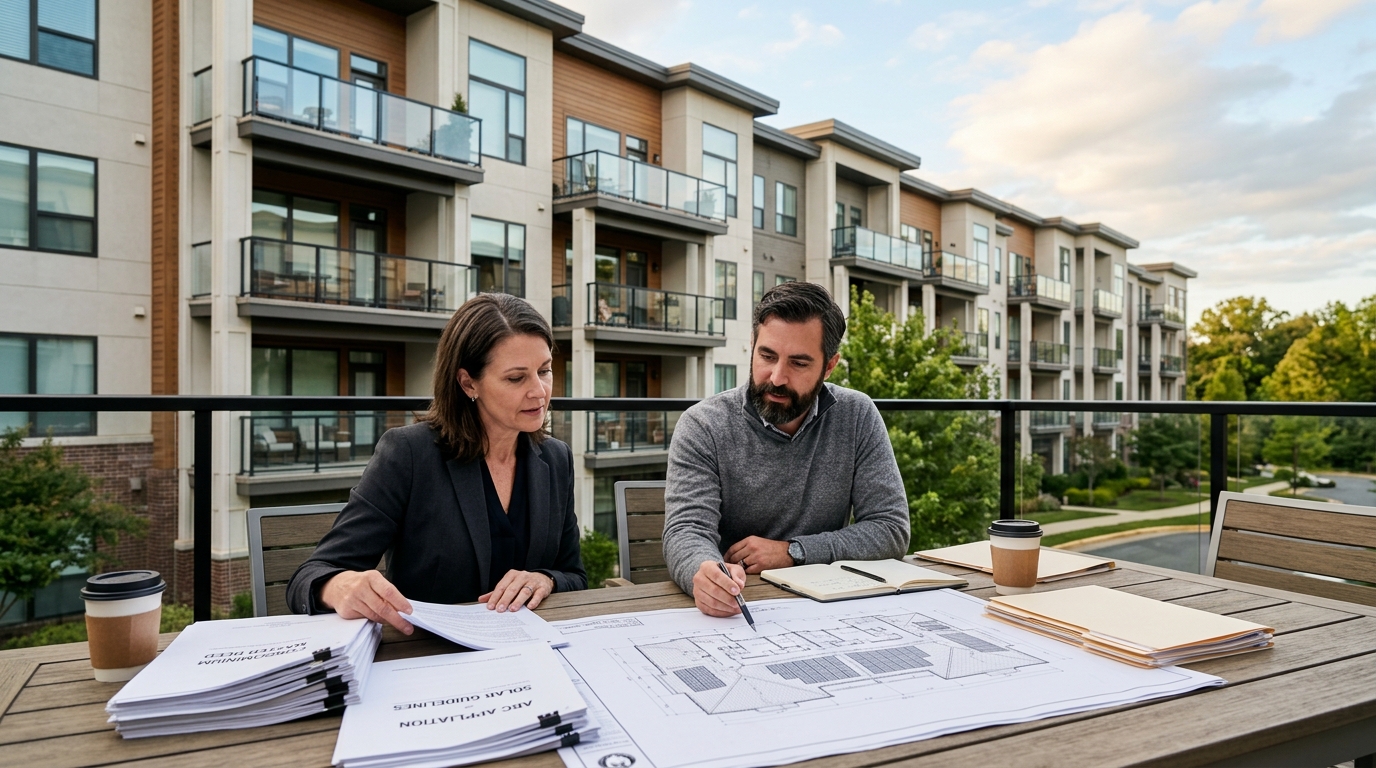
The master deed and bylaws together are the condominium's governing documents. They typically include architectural review requirements: any exterior modification must be submitted to an architectural review committee (ARC) for approval before it's made. Solar panels — even small, balcony-mounted ones — are exterior modifications under virtually every master deed drafted before 2025.
Before HB 395, a condo board that wanted to refuse balcony solar could simply cite its architectural standards or an existing prohibition on exterior modifications. The burden was on the unit owner to get approval; the board had broad discretion to deny it. HB 395 changed that default for compliant plug-in systems.
What HB 395 overrides in existing condo documents
Section § 67-701.1 adds language to the Virginia Solar Rights Act framework that is directly aimed at condominium restrictions. The key provision: any provision of a condominium declaration, bylaws, or architectural standards that has the effect of prohibiting a unit owner from installing a compliant plug-in solar system within their exclusive-use space is void and unenforceable after January 1, 2027.
"Exclusive-use space" is the critical phrase. In a typical high-rise or mid-rise condo, each unit comes with an appurtenant balcony or patio that the unit owner has exclusive use of, even though it may technically be a limited common element. HB 395's protections apply to installations within that exclusive-use space — the owner's own balcony.
Provisions that fall within what HB 395 overrides include: blanket "no solar equipment" clauses in architectural standards, general "no exterior modifications without board approval" provisions applied as a categorical basis for denial, and any ARC criteria that rate balcony solar as automatically non-conforming regardless of installation method or appearance.
What master deeds and boards can still do
HB 395 preserves condo boards' architectural review authority — it eliminates outright bans, not conditional approvals. A board may still require that all exterior modifications go through the ARC process, as long as the ARC applies reasonable criteria that don't effectively prevent balcony solar installation.
Conditions that are still within board authority include:
- Requiring that panels be black-framed and black-backed (for aesthetic consistency with the building's exterior)
- Specifying mounting type (railing clamp only, no wall penetrations)
- Requiring advance submission of product specifications, including the UL 3700 certification number
- Specifying maximum panel size or number of panels, as long as compliant systems within the 1,200 W cap can be accommodated
- Requiring that cabling be secured and bundled, not dangling
- Requiring removal and restoration at the time of unit sale or if the system falls into disrepair
| Provision type | Enforceable after Jan 1, 2027? | Reasoning |
|---|---|---|
| Blanket solar prohibition in bylaws | No | § 67-701.1 voids outright prohibitions |
| ARC review required before installation | Yes | Process preserved; outcome cannot be a blanket denial |
| Black frame/back-sheet requirement | Probably yes | Aesthetic condition achievable with standard equipment |
| No-drill mounting requirement | Yes | Structural protection; doesn't prevent installation |
| 'Invisible from street' requirement (not achievable) | No | Functionally a ban if physically impossible given building layout |
| Removal at sale or lease end | Yes | Standard restoration obligation |
| Outsized insurance mandate | No | Significantly increases cost; § 67-701.1(B)(3) applies |
The common-element question
The trickiest issue in condo balcony solar is the common-element classification. In many condominiums, balconies are legally classified as limited common elements — they're assigned to a specific unit, but the association retains maintenance and structural responsibility for them.
HB 395's exclusive-use protection applies to space the unit owner has the right to occupy and use exclusively, including balconies classified as limited common elements. The limited-common-element designation doesn't eliminate HB 395 protection — it affects maintenance obligations, not the owner's right to install a compliant solar system.
Where common-element classification matters is in genuine structural authority. If a balcony railing is a common element that the association is responsible for maintaining, the association may reasonably ask that any attachment to the railing be done in a way that doesn't compromise its structural integrity or maintenance access. That's a legitimate condition. Using the common-element designation as a basis for blanket refusal — "we won't allow anything attached to common elements" — is not legitimate under HB 395.
Unit owners vs. renters in a condo building
HB 395 creates different frameworks for unit owners and renters in condo buildings, and they don't always move in the same direction.
A unit owner dealing with an HOA or condo board restriction is protected under § 67-701.1. The question is whether the board's architectural review criteria are "reasonable" under the Solar Rights Act framework as amended by HB 395.
A renter in a condo unit — someone leasing from a unit owner — faces two potential authority layers: the unit owner as landlord (governed by § 55.1-1234.1 if the owner has four or more units), and the condo association's architectural standards. The renter's rights under the landlord-tenant framework don't override the association's architectural authority — but the association's rules can't be used by a landlord to fabricate a basis for refusal that HB 395 would otherwise eliminate.
Practical steps for unit owners
Unit owners in condominium buildings who want to install balcony solar should follow a straightforward sequence:
Check the governing documents for any existing solar or modification policies. Look in the declaration, bylaws, and any architectural standards or design guidelines the ARC has published. This tells you what the association currently requires and whether there's an existing policy that will need to be challenged.
Submit to the ARC process with a complete application. Include product model, UL 3700 certification number, mounting method, placement description, and any aesthetic specifications (panel color, cable routing). A complete application is harder to deny on process grounds.
Cite § 67-701.1 in the application. Referencing the statute signals awareness of the legal framework and alerts the ARC that a denial based solely on policy must be justified under the "reasonable restriction" standard.
Document all exchanges in writing. Keep copies of every submission, every ARC response, and every condition proposed.
If the board denies or imposes conditions that seem unreasonable, consult an attorney. CAI-VA maintains a referral list of attorneys familiar with Virginia condo law and HB 395. Virginia Legal Aid can also assist owner-occupants in disputes.
Common questions
Our condo declaration was recorded in 2005. Does HB 395 still override its solar prohibition?
Yes — § 67-701.1 applies to all existing condominium declarations in Virginia, regardless of when they were recorded. A 2005 declaration that prohibits exterior solar installations cannot be enforced to block a compliant HB 395 system after January 1, 2027. The statute supersedes conflicting provisions in earlier documents.
Can the condo board amend the declaration to add more restrictive solar rules after HB 395?
No — any amendment to the declaration or bylaws that attempts to add restrictions exceeding what HB 395 permits is void on enactment. The statutory floor for balcony solar rights can't be lowered by private amendment, any more than it could be contracted around in a lease.
What if our building has a shared roof terrace — can we use that?
HB 395's protections apply to installations within a unit owner's exclusive-use space. A shared roof terrace is a common element without exclusive use assigned to any one unit — it's governed by the association's rules, and HB 395 doesn't create a right to install in shared common elements. Exclusive balconies and patios are a different story.
The ARC approved our neighbor's balcony solar last year. Can the board deny ours?
Inconsistent application of ARC criteria is a recognized problem in HOA law. If the board approved a substantively identical installation for a neighbor but denied the same for another unit, that inconsistency can be raised as evidence of arbitrary application of standards — which is separately problematic under Virginia condo law, independent of HB 395.
Sources: Virginia HB 395 (2025 Session); Code of Virginia § 67-701.1; Code of Virginia § 67-701 (Virginia Solar Rights Act); Virginia Condominium Act (§ 55.1-1900 et seq.); Virginia Property Owners' Association Act (§ 55.1-1800 et seq.).
This article is for general information and does not constitute legal advice. For guidance on a specific situation, consult a Virginia-licensed attorney or your local legal aid office.
Last updated: July 31, 2026
Related Reading
- Learn how association rules interact with state law in our overview of HOA authority under Virginia's Solar Rights Act.
- Examine municipal land-use rules in our guide to local zoning setback guidelines.
- For tenant installation rights in condo buildings, see renter protections under HB 395.
Stay updated on Virginia balcony solar
Get notified when the State Corporation Commission issues new HB 395 regulations, forms, or legal updates.
Was this article helpful?
Your feedback helps us keep this guide accurate and easy to use.