Plug-in vs. full rooftop solar
The HB 395 cap sits at 1,200 W AC. That ceiling defines both what plug-in solar can do — and where it reaches its limit. Here's the honest comparison between the two options for Virginia households.
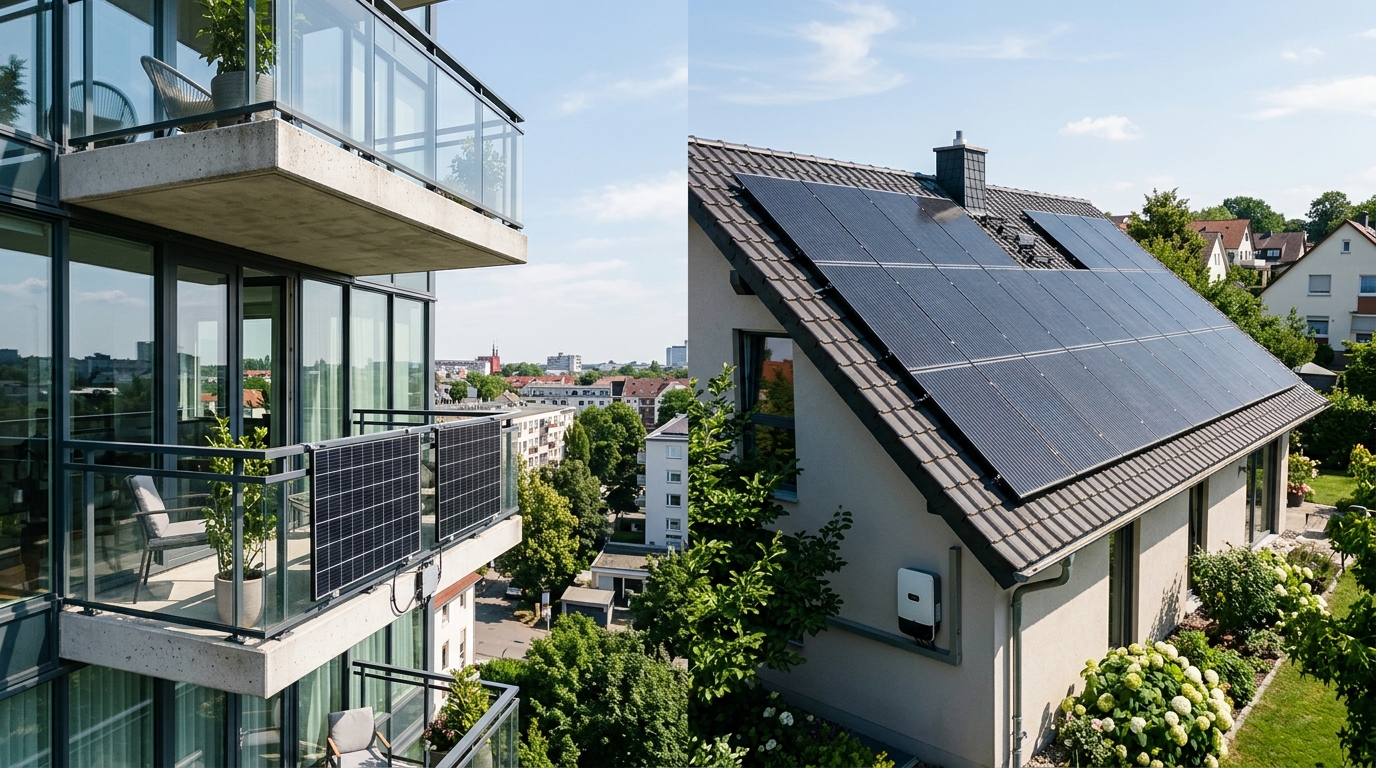
The honest comparison
For renters and condo owners, plug-in solar under HB 395 is often the only viable solar option — rooftop isn't available to them. For homeowners, the choice depends on electricity usage and available roof space. Plug-in solar costs less, installs in an afternoon, and requires no permits. Rooftop solar produces more, qualifies for net metering and the federal tax credit, and has a shorter payback period for high-consumption households. The 1,200 W cap defines where plug-in solar reaches its ceiling.
Who each option is actually for
The choice between plug-in and rooftop solar isn't always a choice — for many Virginia households, only one option is available.
Renters cannot install rooftop solar on a property they don't own. HB 395 makes plug-in balcony solar the legally available path for most apartment and condo renters. Condo unit owners in high-rise or mid-rise buildings typically don't have private roof access; balcony solar is their option too.
Homeowners with a south-facing roof in good condition have a genuine choice. The comparison here is most relevant to them — and to condo owners in townhouse-style buildings where rooftop solar might be architecturally possible.
For households who have the option of both, the comparison isn't about which is inherently "better" — it's about which matches the household's situation: electricity usage, financial position, housing tenure, and risk tolerance.
Cost comparison
Plug-in solar kits in the 400–1,200 W range cost between approximately $650 and $1,400 as of mid-2026, for a complete system including panels, microinverter, mounting hardware, and cables. Installation is a DIY afternoon project — no contractors, no permits, no utility approval process. The all-in cost including self-installation is what's on the price tag.
Rooftop solar systems in the 5–10 kW range — which is the typical residential installation in Virginia — cost between $15,000 and $30,000 before any incentives, and $10,500 to $21,000 after the 30% federal Investment Tax Credit (ITC). Professional installation is required, as is a building permit, utility interconnection agreement, and net metering application. These add-ons typically cost $2,000–$5,000 in time and process overhead beyond the hardware cost.
The cost comparison is not close. A plug-in system costs 5–10% of what a rooftop system costs. The payback comparison is more nuanced because the output and savings are also proportionally different.
| Factor | Plug-in solar (HB 395) | Rooftop solar |
|---|---|---|
| Typical hardware cost | $650 – $1,400 | $15,000 – $30,000 (before ITC) |
| Installation cost | $0 — DIY | $2,000 – $5,000 — professional required |
| Federal tax credit (ITC) | Uncertain — see article | 30% of total cost |
| Permit required | No | Yes — building permit + electrical |
| Utility interconnection | No | Yes — net metering application |
| Typical annual output (VA) | 700 – 1,700 kWh | 6,000 – 12,000 kWh |
| Typical annual savings | $85 – $220 | $750 – $1,500 |
| Payback period | 5 – 9 years (without ITC) | 7 – 15 years (with ITC) |
| Portable / movable | Yes | No |
| Renter-eligible | Yes (under HB 395) | No |
Output comparison
The output gap between plug-in and rooftop solar is significant and unavoidable. A maxed-out HB 395 plug-in system (1,200 W AC) will produce roughly 1,300–1,700 kWh per year in Virginia, depending on location, orientation, and shading. A typical rooftop installation (6–8 kW) produces 6,000–9,000 kWh per year.
The Virginia average residential electricity consumption is approximately 13,000 kWh per year. A rooftop solar system in the 6–8 kW range can cover 45–70% of that usage. A maxed-out plug-in system covers roughly 10–13% of average usage — meaningful, but not transformative for high-usage households.
For lower-consumption households — smaller apartments, households with few high-draw appliances, or households that have already made significant efficiency improvements — the plug-in system's contribution looks proportionally larger. A two-person apartment using 5,000 kWh per year might see a plug-in system cover 25–35% of usage in a good year.
The net metering difference
The most significant financial difference between plug-in and rooftop solar in Virginia isn't the hardware cost — it's net metering eligibility.
Rooftop solar installations connected through a utility interconnection agreement are eligible for net metering under § 56-594 of the Code of Virginia. Net metering credits excess production against future consumption, effectively turning the grid into a battery. On a sunny day in May, a rooftop system might produce 60 kWh; the household uses 20 kWh; the remaining 40 kWh are credited against future bills. Over a year, net metering can significantly increase the financial return on a rooftop system.
HB 395 systems are explicitly classified as behind-the-meter generation and are not eligible for net metering. Excess production in a given hour is effectively donated to the grid. The savings from a plug-in system come entirely from consumption offset in real time — not from credits.
This difference narrowed somewhat by the Virginia Clean Economy Act, which has been gradually compressing Dominion's net metering credit rate. But as of mid-2026, net metering still provides meaningful additional value for rooftop installations that wouldn't be available to a plug-in system of any size.
When plug-in solar makes more sense
Plug-in solar under HB 395 is clearly the right call in several situations:
- For renters. It's the only solar option available under HB 395, and it doesn't require any capital outlay beyond the hardware itself.
- For condo owners without roof access. Same situation as renters in terms of physical access; HB 395 provides the legal path where HOA restrictions might otherwise block it.
- For homeowners testing solar before a larger investment. A $1,200 plug-in system lets a household understand its roof's solar potential, its own consumption patterns, and its comfort with home energy equipment before committing $20,000 to a rooftop system.
- For short-term housing situations. A plug-in system moves when a renter moves. Rooftop solar is tied to the property.
- For households with low electricity consumption. When annual consumption is under 5,000 kWh, a plug-in system covers a substantial share of usage and the financial case for a full rooftop system is weaker.
When rooftop solar makes more sense
Rooftop solar is the better choice when:
- The household owns the property long-term. The payback period for rooftop solar assumes a 10–15 year ownership horizon. A renter or short-term owner won't capture the full payback.
- Electricity consumption is high. Above 10,000 kWh per year, rooftop solar's larger output creates proportionally larger savings. The ITC further improves the economics.
- The roof has good south-facing exposure and minimal shading. Rooftop systems can be optimized for the specific property in ways that a balcony railing can't.
- The household wants to power an electric vehicle. EV charging adds several thousand kWh to annual consumption; a 1,200 W plug-in system can't meaningfully offset that. A full rooftop system can.
- The household wants battery storage. Home battery systems — Powerwall, etc. — are designed to work with rooftop systems, not plug-in systems. The behind-the-meter-only classification of HB 395 systems means they don't integrate with home battery products in the same way.
For households who might upgrade later
Some homeowners are starting with a plug-in system as a first step, with an eye toward upgrading to rooftop solar in a few years. This is a reasonable strategy with one practical note: plug-in systems and rooftop systems are separate in Virginia's regulatory framework.
When a homeowner does install rooftop solar, the plug-in system doesn't need to be removed — it continues as a separate, behind-the-meter system. But the rooftop system's interconnection agreement and net metering application cover only the rooftop installation, not the plug-in system. The two coexist as legally separate generation sources with different regulatory treatments.
The financial calculation for the upgrade path: the $1,200 spent on a plug-in system isn't wasted — it generates savings during the plug-in phase and can continue generating after the rooftop upgrade. It just doesn't offset the cost of the rooftop system itself.
Common questions
Can a homeowner have both a plug-in system and rooftop solar?
Yes — they're treated as separate systems under Virginia law. The rooftop system goes through normal interconnection and net metering. The plug-in system continues as a behind-the-meter HB 395 system. They coexist without legal conflict.
Does the 30% ITC apply to plug-in solar?
This is an unsettled question. The IRS's guidance on the residential clean energy credit (§ 25D) is designed around grid-connected systems with bidirectional meters. Plug-in systems are deliberately excluded from grid interconnection under HB 395. IRS guidance published as of mid-2026 doesn't directly address plug-in solar systems. Consult a tax professional before claiming the credit for a plug-in system. See the incentives article for a full breakdown.
What happens to a plug-in system if I sell my condo or house?
A plug-in system is personal property, not a fixture of the building. It moves with the owner, not with the property. A rooftop system is typically a fixture and transfers with the property sale (which has implications for the ITC recapture rules and for the buyer's valuation).
Is a community solar subscription a third option?
Community solar programs — where customers subscribe to a share of an off-site solar installation — exist in Virginia and are available to renters who can't install anything on-site. They offer bill credits proportional to the subscriber's share of the installation's output. They're different from both plug-in solar (which requires on-site equipment) and rooftop solar (which requires owning the roof). Virginia's community solar program is currently limited in scale but expanding.
Sources: Virginia HB 395 (2025 Session); Code of Virginia § 56-594 (net metering); Virginia Clean Economy Act; IRS Publication 5695 (Residential Energy Credits); NREL PVWatts Virginia irradiance data (2025); Lawrence Berkeley National Laboratory Tracking the Sun 2024.
This article is for general information and does not constitute financial or tax advice. Consult a tax professional regarding the federal investment tax credit.
Last updated: July 31, 2026
Related Reading
- Examine initial equipment costs and payback math in our detailed kit cost and ROI payback analysis.
- See how the 30% ITC impacts system payback in our guide to federal tax credit eligibility.
- For a complete introductory overview, read our comprehensive beginner's balcony solar guide.
Stay updated on Virginia balcony solar
Get notified when the State Corporation Commission issues new HB 395 regulations, forms, or legal updates.
Was this article helpful?
Your feedback helps us keep this guide accurate and easy to use.