Anti-islanding: how plug-in solar stays safe
It's the single safety feature that made plug-in solar politically possible. Without it, HB 395 doesn't get out of committee — with it, utilities dropped their objections.
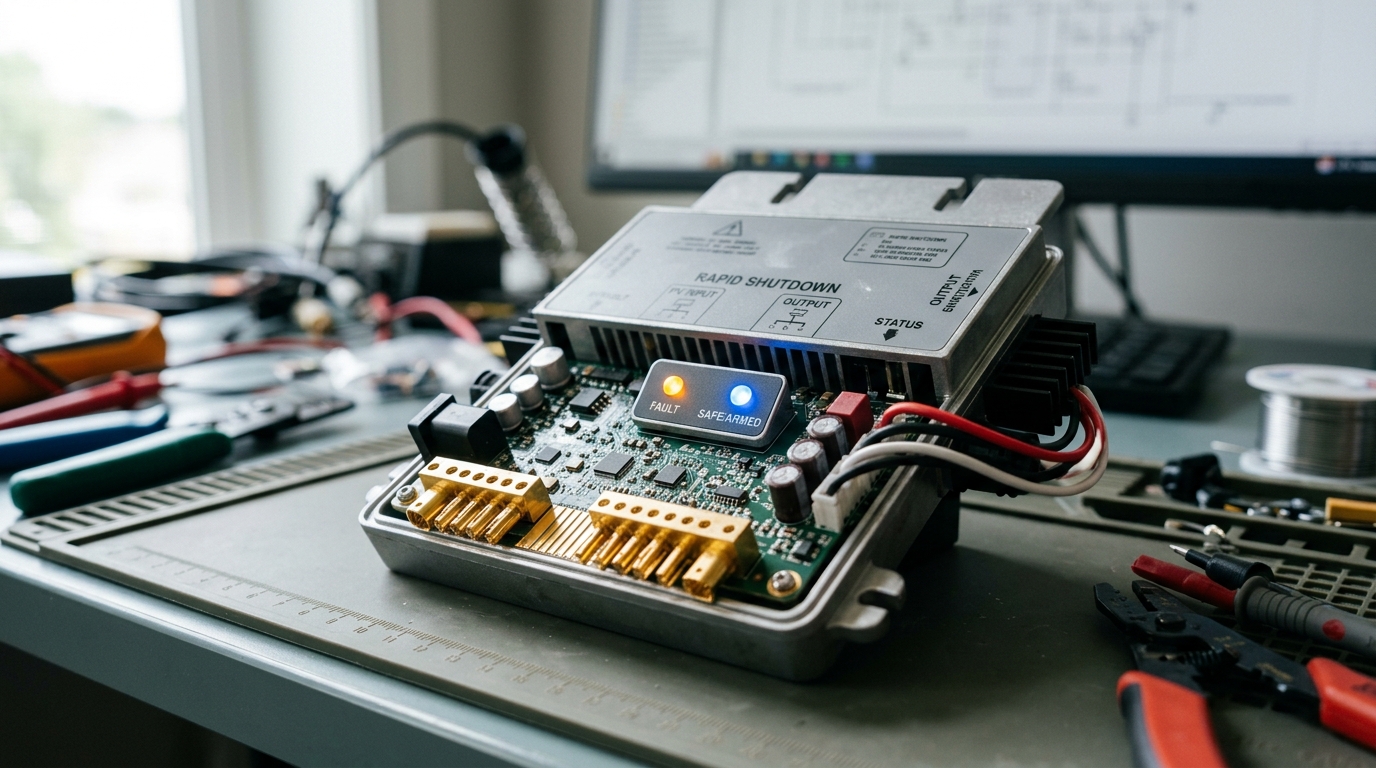
The problem it solves
When utility power goes out on your street, the utility assumes the lines are dead. A line worker climbs a pole to fix the fault. If your balcony solar system kept feeding power onto the local grid during the outage — creating a small "island" of live circuit — the line worker could be electrocuted.
Anti-islanding is the technical mechanism that guarantees this doesn't happen. Every UL-certified plug-in solar system contains a microinverter that constantly monitors grid voltage and frequency, and disconnects itself within milliseconds if the grid disappears.
How it works
The microinverter is doing two jobs at once:
Sensing. It measures the grid's 60 Hz sine wave hundreds of times per second, watching for voltage and frequency excursions outside a narrow band (typically 88.4–110% of nominal voltage; 59.3–60.5 Hz).
Perturbing. It injects a tiny frequency shift into its own output. If it's connected to a stable grid, the grid absorbs the shift. If the grid is gone, the shift feeds back on itself and drives frequency out of bounds almost immediately.
The moment either check fails, the inverter opens its output relay and stops producing AC. It waits at least five minutes after the grid returns to stable before reconnecting.
Why milliseconds matter
UL 3700 (and its parent standard IEEE 1547) require anti-islanding to trip within 2 seconds of a grid outage. Modern microinverters routinely do it in under 100 milliseconds. The gap between "worst-case allowed" and "typical actual" is what gives utility engineers confidence in the standard.
How it's tested
UL 3700 certification requires the inverter to pass anti-islanding under three test conditions:
- Balanced local load (inverter output matches local demand exactly — the hardest case).
- Weak grid conditions (high source impedance).
- Combined with other on-site inverters (multi-inverter interaction).
The certification is renewed every time the manufacturer changes firmware. This is one reason HB 395 requires the UL 3700 mark to appear on the inverter itself, not just on the box.
What can go wrong
Very little, in practice — but the failure modes worth knowing:
Aftermarket firmware. Flashing custom firmware to a microinverter voids the UL certification, and possibly the anti-islanding trip time.
Series-string workarounds. DIY setups that put multiple panels through a single generic inverter defeat the per-panel monitoring UL 3700 assumes.
Battery add-ons without an ATS. Adding a battery to backfeed the house creates an intentional island — legal for off-grid mode, illegal on the grid without a proper transfer switch.
"The safety of plug-in solar rests on trusting the inverter. HB 395's UL 3700 requirement is that trust made statutory.
"
Related Reading
- Learn how grid isolation is tested under UL 3700 safety testing standards.
- Understand panel-level safety hardware in our guide to microinverter rapid shutdown mechanisms.
- See how safety functions interact with utility meters in behind-the-meter utility operation.
Stay updated on Virginia balcony solar
Get notified when the State Corporation Commission issues new HB 395 regulations, forms, or legal updates.
Was this article helpful?
Your feedback helps us keep this guide accurate and easy to use.