Microinverters vs. string inverters
Every HB 395-compliant plug-in solar system uses a microinverter, not a string inverter. This isn't just a product choice — it's a technical necessity rooted in how plug-in systems connect to the building's electrical system and how UL 3700 defines safe operation.
Direct answer
Plug-in solar under HB 395 requires microinverters — not string inverters — because a microinverter converts DC power to AC at the panel level and outputs standard 120V AC that can be safely fed into a residential outlet. String inverters produce higher-voltage AC output designed for dedicated electrical connections, not standard outlets. UL 3700, the safety certification required by HB 395, is specifically designed for microinverter-based plug-in systems and doesn't apply to string inverters. A string-inverter-based system is not HB 395-compliant, regardless of its wattage.
What an inverter does
Solar panels produce direct current (DC) electricity — electrons flowing in one direction. The building's electrical system runs on alternating current (AC) — electrons that switch direction 60 times per second at a regulated voltage. Everything that plugs into a wall outlet expects AC. An inverter is the device that converts solar DC to grid-compatible AC.
Without an inverter, solar electricity can't power household appliances or feed into a building's wiring. The inverter is what makes a solar panel into something useful.
There are two fundamentally different ways to deploy an inverter in a solar installation: string inverters, where one central inverter handles the DC output of multiple panels in series, and microinverters, where each panel has its own dedicated inverter. For plug-in solar, only the microinverter approach works — and HB 395's framework is built around it.
String inverters: how they work and why they don't work for balcony solar
A string inverter receives DC electricity from a series (or "string") of panels connected in sequence. The DC voltage from multiple panels adds up — a string of six 400 W panels might produce 300V DC or more at the inverter's input. The inverter converts this high-voltage DC to AC, typically at 240V for U.S. residential systems or higher for commercial installations.
That 240V AC output is designed to connect to a dedicated electrical subpanel or direct utility interconnection — not to a standard 120V wall outlet. A string inverter's output would damage or short a standard residential outlet. Connecting a string inverter to a regular outlet is electrically unsafe and entirely incompatible with the plug-in solar concept.
String inverters are also typically larger, heavier, and more expensive than microinverters. They're designed for roof-mounted arrays where the inverter is installed in a utility room or garage and wired to the electrical panel by a licensed electrician.
Microinverters: the plug-in solar approach
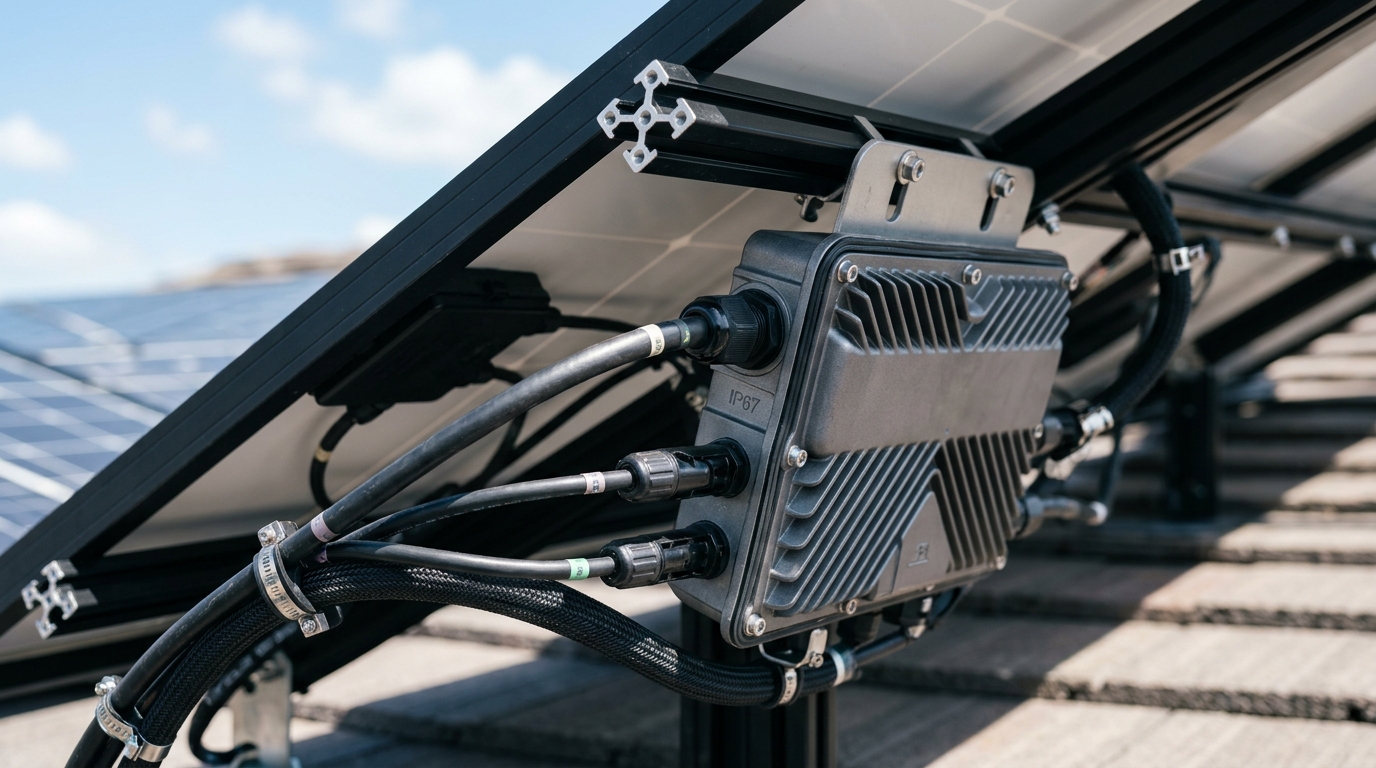
A microinverter is physically attached to or integrated with a single solar panel. It receives that panel's DC output — typically 30–50V DC from a 300–500 W panel — and converts it directly to 120V AC. The AC output is the same voltage as a standard U.S. residential outlet.
This is why plug-in solar works: the microinverter produces exactly the voltage and frequency that a residential outlet expects. The system's output cable terminates in a standard plug that connects to an outdoor outlet, feeding power directly into the building's electrical system at the point of connection.
Each microinverter handles only the output of its own panel. In a two-panel plug-in kit, there are either two individual microinverters (one per panel) or a single "dual microinverter" — a device that manages two panels simultaneously but outputs 120V AC. Both configurations produce standard residential outlet-compatible AC power.
Why plug-in solar structurally requires microinverters
The plug-in solar concept rests on one foundational requirement: the system must output electricity at the same voltage and frequency as the building's standard outlets, so it can safely connect through a standard plug. That requirement makes microinverters the only viable inverter technology.
A string inverter produces the wrong voltage for a standard outlet connection. A central battery-based system with its own inverter could theoretically produce 120V AC, but it would be generating power from stored energy rather than directly from solar panels, and wouldn't qualify as a plug-in solar system under HB 395's definitions.
The microinverter's per-panel architecture also provides safety advantages that matter for plug-in deployments. If one panel is shaded, dirty, or partially damaged, only that panel's output drops — the other panels continue operating at full capacity. In a string inverter setup, the worst-performing panel in the string drags down the output of all others.
UL 3700 and the microinverter requirement
UL 3700, the safety standard HB 395 requires for all compliant systems, was specifically written for plug-in solar systems built around microinverters. The standard tests the complete system — panel, microinverter, connecting cable, and plug — as an integrated unit.
The safety testing in UL 3700 assumes 120V AC output from a microinverter connecting to a residential outlet. It tests for anti-islanding compliance (the ability to disconnect within milliseconds of a utility outage), sustained AC load performance, ground-fault protection, backfeed current limits, and plug and connector safety.
String inverter systems have their own UL certification standards (primarily UL 1741), but UL 1741 is for utility-interactive systems — systems connected through formal interconnection agreements. UL 3700 and UL 1741 are parallel standards for different product categories, and a UL 1741-certified string inverter doesn't satisfy HB 395's UL 3700 requirement.
| Feature | Microinverter (plug-in solar) | String inverter (rooftop solar) |
|---|---|---|
| Output voltage | 120V AC — outlet compatible | 240V AC or higher — subpanel required |
| DC input voltage | 30–55V DC (single panel) | 200–600V DC (multiple panels in series) |
| Connection method | Standard plug into wall outlet | Direct wiring to electrical panel |
| Applicable UL standard | UL 3700 (plug-in systems) | UL 1741 (utility-interactive systems) |
| Panel mismatch effect | Only affected panel loses output | Weakest panel reduces entire string output |
| Physical size | Small — mounts behind or on panel | Large — wall-mounted unit in utility room |
| Electrician required? | No — plug-in connection | Yes — licensed electrical work required |
| HB 395 compliant? | Yes (with UL 3700 certification) | No |
Reading inverter specs when buying a plug-in solar kit
When evaluating a plug-in solar kit for HB 395 compliance, the inverter specification sheet is the most important document. Here's what to look for:
AC output voltage. Should read 120V or 120/240V for a split-phase capable unit. If it says 240V AC only, it's not a microinverter designed for standard outlet connection.
AC output power rating. This is the HB 395-relevant number. Must be 1,200 W or less. Stated in watts (W) or kilowatts (kW). A 1.2 kW rating is the ceiling.
UL 3700 certification. Should appear on the product label, spec sheet, and UL's online certification directory. The certification number can be cross-referenced at ul.com/csa.
Inverter type classification. Should read "microinverter," "plug-in solar inverter," or "balcony inverter" — not "string inverter," "central inverter," or "utility-interactive inverter."
Grid connection method. Should specify "outlet plug" or "NEMA 5-15P plug" (the standard three-prong plug). Not "hardwired" or "subpanel connection."
Common questions
Can I buy panels and a separate microinverter and combine them myself?
Technically yes — panels and microinverters are sold separately, and some installers source them independently. But the UL 3700 certification covers specific system configurations: a listed panel with a listed microinverter in a listed configuration. Mixing uncertified components, or combining components outside a certified configuration, may produce a system that doesn't carry the required certification. Check the microinverter manufacturer's compatibility documentation carefully.
What's the difference between a microinverter and a "power optimizer"?
A power optimizer is a DC-to-DC converter that conditions the panel's output before sending it to a central string inverter. It doesn't convert to AC at the panel level — it hands off conditioned DC to the string inverter, which does the AC conversion. Power optimizers don't produce 120V AC output and aren't compatible with plug-in outlet connection. They're not microinverters and don't satisfy HB 395's requirements.
Why do some plug-in solar kits advertise "800 W DC" on the panel but "600 W AC" on the inverter?
This DC/AC gap is normal and expected. Solar panels produce more DC power than the microinverter converts to AC — the difference accounts for conversion losses and for the reality that panels rarely operate at their peak nameplate DC rating in real-world conditions. The relevant compliance number is the inverter's AC output: 600 W AC in the example. The panel's DC rating doesn't affect HB 395 compliance.
Is there any scenario where a string inverter could be used for balcony solar?
Not under HB 395. A system using a string inverter would require a direct electrical connection to the building's wiring — not a standard outlet — which takes it out of the plug-in solar category defined by the statute. It would also lack UL 3700 certification. A string-inverter system might qualify as a rooftop solar installation (with interconnection, permits, and net metering), but it's not an HB 395 plug-in system.
Sources: Virginia HB 395 (2025 Session); UL Standard 3700 — Standard for Plug-In Electric Vehicle Supply Equipment (2023 edition); UL Standard 1741 — Standard for Inverters, Converters, Controllers and Interconnection System Equipment for Use With Distributed Energy Resources; National Electrical Code (NEC) 2023 — Article 690 (Solar Photovoltaic Systems); IEC 62109-1 (Safety for Power Converters for Use in Photovoltaic Power Systems).
This article is for general information. For specific electrical installation questions, consult a licensed electrician familiar with Virginia's residential electrical code.
Last updated: July 31, 2026
Related Reading
- Review mandatory safety standards in our guide to UL 3700 rapid shutdown specifications.
- Learn how grid shutdown protection operates in anti-islanding grid isolation.
- Understand system capacity limits in our breakdown of the 1,200 W AC power ceiling.
Stay updated on Virginia balcony solar
Get notified when the State Corporation Commission issues new HB 395 regulations, forms, or legal updates.
Was this article helpful?
Your feedback helps us keep this guide accurate and easy to use.