Appalachian Power Company (APCo)
APCo serves roughly a third of Virginia's electricity customers, primarily in western and southwestern Virginia. Its approach to HB 395 plug-in solar diverges from Dominion's in a few meaningful ways — most notably in its notification process and its meter estate in rural areas.
Direct answer
Appalachian Power Company has endorsed HB 395's plug-in solar framework and does not require an interconnection agreement for compliant systems. APCo asks customers to submit a voluntary notification before installation — currently via phone or its online account portal. Like Dominion, APCo standard meters don't credit backfeed from HB 395 systems. APCo's approach diverges from Dominion's primarily in notification logistics and in how it's addressing rural areas where older mechanical meters are still in use.
APCo's service territory
Appalachian Power Company serves approximately 550,000 customers in Virginia, primarily in the western and southwestern parts of the state — including the Roanoke Valley, New River Valley, Bristol, and the coalfields region. The service territory also extends into parts of West Virginia and Tennessee under the same American Electric Power (AEP) parent company umbrella.
This geographic distribution matters for plug-in solar in a practical sense. Western Virginia has different solar irradiance patterns than coastal or Northern Virginia — generally more cloud cover, and more pronounced seasonal variation due to mountain topography. The seasonal performance calculations for an APCo-served customer in Roanoke will differ from those for a Dominion-served customer in Richmond. See the seasonal performance article for region-specific numbers.
In terms of HB 395 implementation, APCo's service territory also has a higher proportion of older metering infrastructure in rural areas, which creates a slightly different factual background for the "backfeed" question than Dominion's more modernized meter estate.
APCo's notification process
APCo's voluntary notification process for HB 395 plug-in solar is available through two channels: a dedicated phone line staffed during business hours, and an online form embedded in its customer account portal. Both channels request the same information: the customer's account number, the system's manufacturer and model, the AC output rating, and the installation address.
Unlike Dominion, which built a standalone HB 395-specific notification form, APCo has integrated the notification into its general customer account system. Customers who submit through the portal get a confirmation number they can include in any landlord notice or HOA submission that references utility notification.
APCo emphasizes — as the statute requires — that the voluntary notification doesn't trigger any review, approval, or inspection process. Submitting it doesn't create any rights or obligations beyond creating a record. APCo's draft FAQ published in May 2026 states explicitly that "APCo does not inspect HB 395 plug-in solar installations and does not approve or deny installation requests."
How APCo meters handle small backfeed
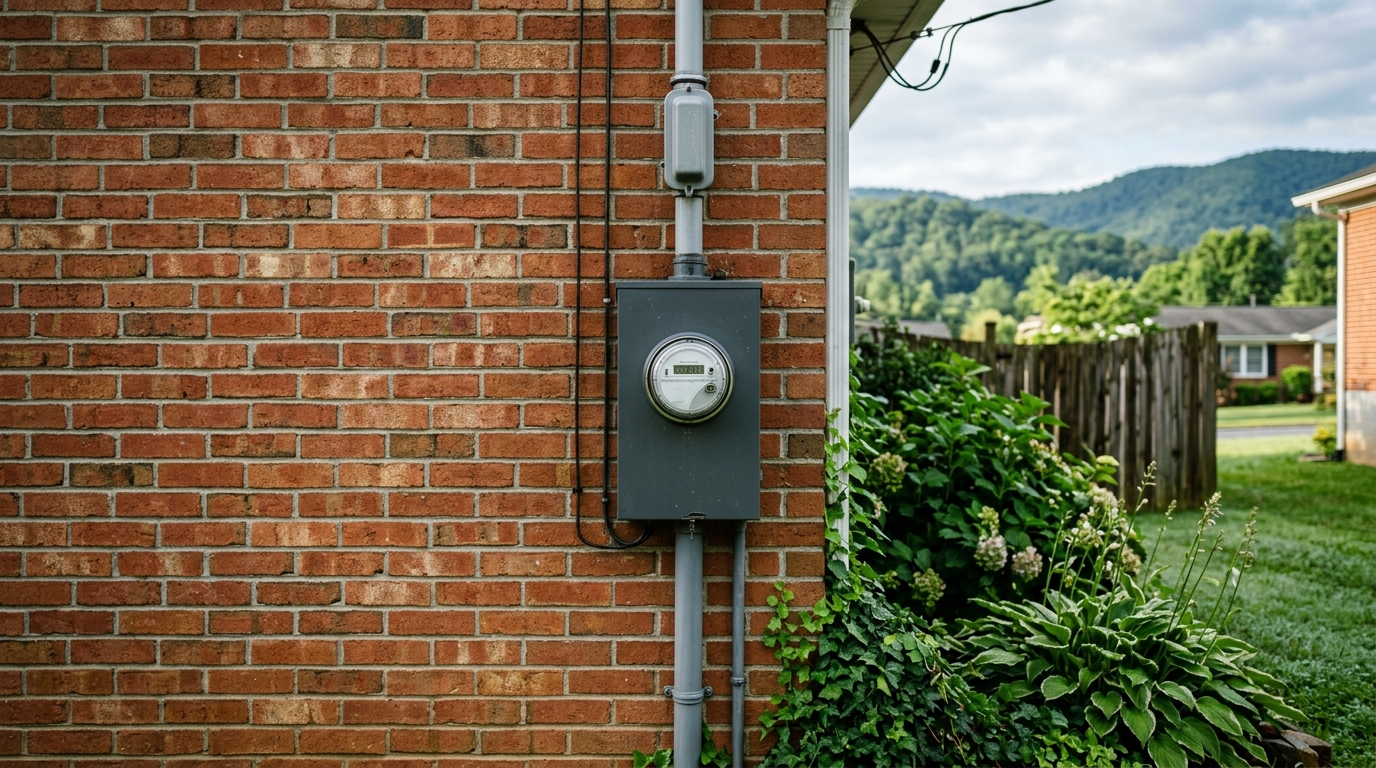
The vast majority of APCo customers in urban and suburban areas have modern smart meters (AMI meters) that can accurately measure power flow in both directions. When an HB 395 system produces more power than the tenant is consuming at a given moment, any excess flows back to the grid. The APCo smart meter records this flow but does not credit it — the meter reads the net consumption for billing purposes, and backfeed that exceeds consumption in a given interval is effectively donated to the grid.
In rural areas, a meaningful proportion of APCo customers still have older mechanical induction disk meters. These meters physically spin backward when power flows from the customer to the grid. This can look like a credit on the meter reading — but it isn't. The mechanical reversal does reduce the measured consumption for billing purposes during the interval it occurs, but APCo's billing system applies corrections for this when it's detected, and the utility's official position is that HB 395 systems are not entitled to any compensation for backfeed regardless of meter type.
APCo has committed to replacing the remaining mechanical meters in areas with significant HB 395 adoption within its accelerated meter modernization program, with completion expected by late 2027.
APCo vs. Dominion: key differences
| Issue | Dominion Energy Virginia | Appalachian Power Company |
|---|---|---|
| Interconnection agreement | Not required for HB 395 systems | Not required for HB 395 systems |
| Notification method | Standalone online form (solarapp.dominionenergy.com) | Phone or customer account portal |
| Net metering eligibility | Not applicable — behind-the-meter classification | Not applicable — same classification |
| Meter type (most customers) | Smart meter (AMI) — virtually universal | Smart meter (AMI) — suburban; mechanical in some rural areas |
| Backfeed handling | Recorded, not credited | Recorded, not credited; mechanical meter areas have billing correction applied |
| Draft customer FAQ | Published June 2026 | Published May 2026 |
| Customer assistance line | Dedicated HB 395 line | General residential line with HB 395-trained staff |
Net metering: same rule as Dominion, different tariff backdrop
Under HB 395 and Virginia Code § 56-594, plug-in solar systems are classified as behind-the-meter generation and are not eligible for net metering regardless of which utility serves the customer. This rule applies equally to Dominion and APCo customers.
Where APCo and Dominion differ is in their baseline residential tariff structures. APCo's residential rates are generally lower than Dominion's — and the rate differential affects the savings calculation for APCo customers compared to Dominion customers with identical systems. A system that saves a Dominion customer $200 per year in bill reduction may save an APCo customer $150–$170, because the offset-per-kWh calculation runs against a lower base rate.
This doesn't change the legal framework, but it matters for financial planning. APCo customers should use Virginia-specific and APCo-rate-specific calculations when estimating payback periods. See the cost and savings article for the worked math, including an APCo-specific scenario.
Co-op service areas within and adjacent to APCo territory
Parts of western and southwestern Virginia that appear on APCo territory maps are actually served by rural electric cooperatives — notably BARC Electric Cooperative, Craig-Botetourt Electric Cooperative, and a few others. APCo doesn't serve these customers; the co-ops do, and they have their own approaches to HB 395.
The easiest way to verify which utility actually serves a specific address is to check the utility's online service territory map or call the customer service line. If a co-op serves the address, see the electric co-ops and municipal utilities article for co-op-specific guidance.
Common questions
Does APCo require an inspection before I install?
No — APCo's May 2026 FAQ is explicit that it does not inspect HB 395 installations and does not process approval requests. Voluntary notification doesn't trigger any review process.
My APCo bill doesn't show a credit for my solar production. Is that correct?
Yes — HB 395 systems are not eligible for net metering credits. The savings from a plug-in solar system come from reducing consumption in real time, not from a bill credit. If the system produces power while appliances are running, the meter records lower consumption. That lower consumption shows up as a smaller bill — but not as a line-item credit.
I have a mechanical meter. Will my bill go down when my panels produce?
Only during periods when the system is producing more than you're consuming. In those moments, the mechanical meter's disk may rotate backward, which reduces the net reading. APCo applies billing corrections when it detects systematic backward rotation that exceeds normal measurement tolerance. The bottom line: mechanical meter customers may see marginal bill reductions, but shouldn't expect the same accuracy as smart meter customers in tracking their offset.
Can APCo disconnect service because I installed a plug-in solar system?
No — an HB 395-compliant system that is UL 3700 certified, rated at 1,200 W AC or less, and connected to an existing outlet is not grounds for service disconnection. APCo's draft FAQ addresses this directly: "APCo does not disconnect service based on the presence of a compliant HB 395 plug-in solar system."
Sources: Virginia HB 395 (2025 Session); Code of Virginia § 56-594; Appalachian Power Company HB 395 Customer FAQ (draft, May 2026); APCo Meter Modernization Program Progress Report (Q1 2026); SCC HB 395 Stakeholder Docket (PUR-2025-00147).
This article is for general information and does not constitute legal advice. Tariff and billing information reflects APCo draft guidance as of July 2026 and may change as SCC proceedings conclude.
Last updated: July 31, 2026
Related Reading
- For member-owned utilities like NOVEC and REC, see electric co-op and municipal utility rules.
- Compare APCo policies with Dominion Energy notification requirements.
- Learn why plug-in systems offset daytime consumption directly in behind-the-meter generation principles.
Stay updated on Virginia balcony solar
Get notified when the State Corporation Commission issues new HB 395 regulations, forms, or legal updates.
Was this article helpful?
Your feedback helps us keep this guide accurate and easy to use.